Feed the Cups Beer Foam and Cocktails: Kegs, Overflow, and Shakers
How beer foam pouring, keg yields, cocktail ice cuts, and Shaker mixes work across 59 wine-category drinks and Bar Street stages.
Part of Feed the Cups Drinks and Recipes Guide: Sizes, Ranks, Devices, and Top Prices.
Each tap serving pulled from a beer keg generates one matching serving of foam, so a single pour fills a small glass holding 2 portions, two pours fill a medium glass holding 4 portions, and three pours fill a large glass holding 6 portions without spilling over. Across the drinks catalog, 59 recipes sit in the wine category, combining poured drafts built from 6 beer kegs ( Lager,
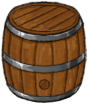 Ale,
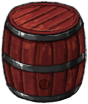 Pilsner,
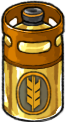 Wheat Beer,
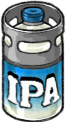 IPA, and
 Stout) with spirit cocktails mixed in a
 Shaker.
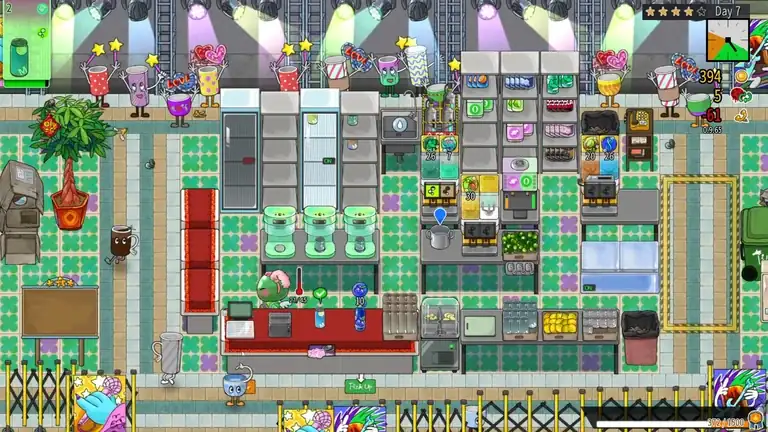
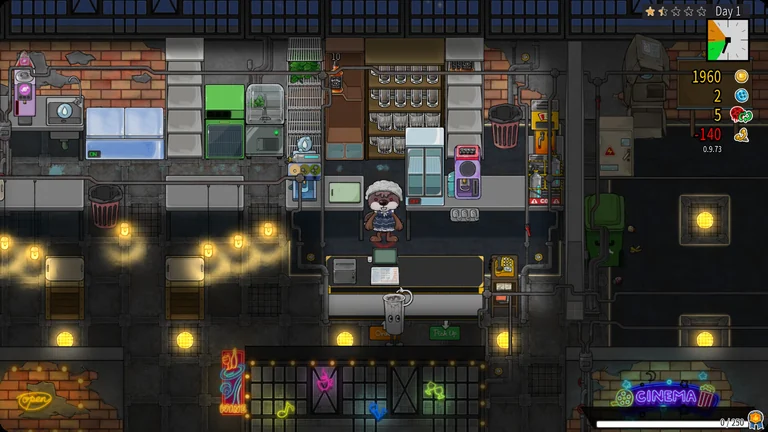
 Bar Street is the 8th chapter, carries the Cocktail focus, and introduces foam-level orders, shaped ice, and full-batch flair throws. For cup capacity rules, menu ranks, and every other recipe group, start with the drinks and recipes guide.
How Beer Foam Pouring and Overflow Levels Work
Set a wooden beer barrel on a table and attach a tap before opening service. Once opened, the tap keeps running until you shut it off; leaving it open pushes foam past the rim and can downgrade the order to a neutral review.
Because liquid beer and foam both count as beer portions inside the glass, the beer count on a recipe card reflects occupied cup space rather than raw tap clicks. After pouring one serving of milk into a medium glass, three spaces remain, so two beer pours fill the glass cleanly and a third pour forces overflow — the exact 1-plus-3 layout behind  Milk Beer Lager (base price 78 cup coins).
Every overflow step alters the shape and icon of the glass, and large beer orders span four foam states: no overflow, slight overflow, moderate overflow, and significant overflow. Customers check the exact foam level on their ticket; you can still sell a cup with mismatched foam, though you risk losing the good review.
The order in which you add beer and mixers controls which overflow state you hit:
- No overflow or slight overflow: pour the non-beer mixer first, then tap two or three servings of beer on top — matching 1+3 mixes such as
 Imperial Stout Bomb (base price 62 cup coins, Vodka plus Stout) and 3+3 mixes like
 Liquid Bread (base price 186 cup coins, apple juice plus Wheat Beer).
- Moderate overflow: start with beer before adding the mixer — tap three servings of beer into slight overflow before adding Vodka on a 1+3 mix, or tap two servings of beer, pour three servings of apple juice into slight overflow, and finish with one last serving of beer on a 3+3 mix.
- Significant overflow: fill a large glass with three servings of beer first, then pour three servings of apple juice into the foam-filled cup.
Bar setups that pair a metal beer keg with a CO2 gas bottle tie carbonation quality to placement: setting the keg closer to the gas bottle improves carbonation, so you need to watch bubbles alongside foam height. Beer glasses also accept toppings such as prunes,  Gummy Bear, and egg wash, plus
 Candied Cherry as a glass garnish. For general heating, measuring, and topping workflows across earlier chapters, see the drink prep steps guide.
Beer Keg Ingredients, Costs, and Yields
All 6 beer ingredients deliver one barrel per box and dispense 40 portions from each barrel, with foam portions drawn from the same tap:
- Lager costs 90 cup coins per barrel and powers small Unfiltered Lager (base price 14) as well as large Strawberry Draft Lager (base price 53).
- Ale costs 98 cup coins per barrel and backs medium pours such as Cherry Ale (base price 63) and
 Beer Margarita (base price 81).
- Pilsner costs 110 cup coins per barrel and appears in Passion Fruit Sour Beer (base price 74) and Bomb Shot (base price 86).
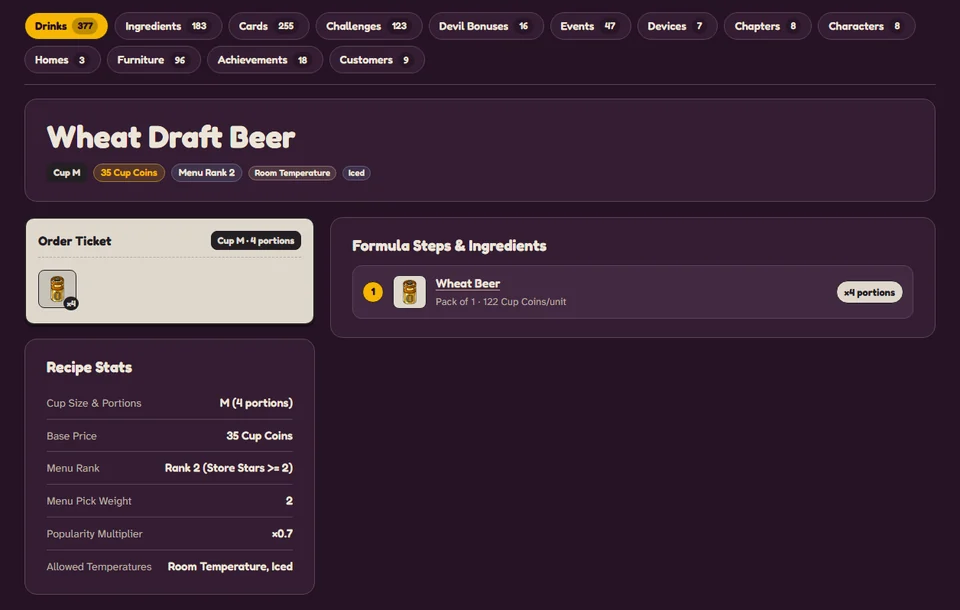
- Wheat Beer costs 122 cup coins per barrel and builds Wheat Draft Beer (base price 35) alongside Liquid Bread (base price 186).
- IPA costs 130 cup coins per barrel and anchors
 Mojito Draft Beer (base price 110) and
 Ginger IPA (base price 174).
- Stout costs 138 cup coins per barrel, the steepest keg cost, pairing into Imperial Stout Bomb (base price 62) and Butter Stout (base price 235).
Keep kegs off the floor on a keg rack and never dump empty kegs into trash cans. Whenever you order a new keg, the courier takes one empty keg back and refunds the deposit; if empties stack up, you can pay the fee to call the empty keg recycling service directly. Used glasses and mistimed pours go into the dishwasher, which cleans four glasses per run before you carry them on a tray back to the glass rack.
Mixing Cocktails with the Shaker, Ice Cuts, and Spirits
Cocktails draw from four-bottle cases that yield 10 portions per bottle, priced per bottle at 18 cup coins for  Rum, 20 for
 Blue Curaçao, 22 for
 Coffee Liqueur, 26 each for
 Red Wine and
 Whiskey, 28 each for Vodka and
 Cream Liqueur, 30 for
 Gin, 32 for Tequila, and 35 for
 Brandy.
Before pouring spirits, freeze water in an insulated box inside the freezer to form ice cubes, which melt back to water once taken out. Cut ice into crushed ice, an ice ball, or an ice spear and drop it into an empty glass first; crushed ice and an ice ball take one ice portion each, whereas an ice spear takes two.
Direct-pour cocktails do not always fill the glass completely: Mizuwari Whiskey (base price 17 cup coins) uses two liquid portions while Hot Toddy (base price 79 cup coins) uses four, and both serve in a classic glass. Up to three garnishes can be added to a cocktail in any order, and putting a  Fresh Lemon or
 Fresh Orange through a peeler into a topping container creates peel garnishes while leaving the fruit ready to juice.
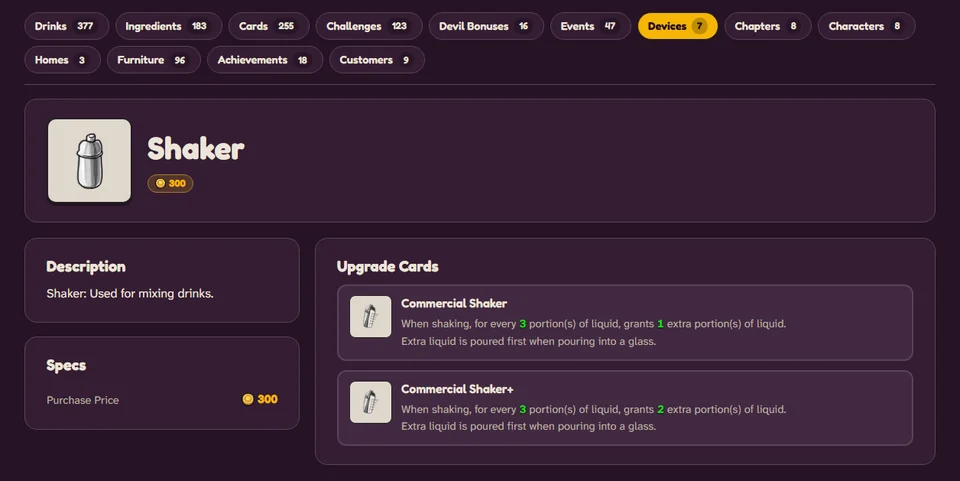
Shaken recipes center on the Shaker, which costs 300 cup coins through the phone shop, keeps neatly on a small rack or inside a liquor cabinet, and holds up to 6 portions:
- Fixed-ratio bases: the Shaker produces 10 fixed-ratio shaken liquors whose output portions equal the sum of their inputs, including mixes built from Gin, Fresh Lemon, and crushed ice.
- Ice and straining: add crushed ice only once regardless of batch size — doubling the liquor raises shaking time — and remember that strained pours leave the Shaker iceless, so crushed ice still goes into the serving glass beforehand.
- Eggs and oranges:
 Egg additions occupy extra slots rather than liquid slots inside the Shaker (three shaken liquors take one Egg per base batch rather than one per poured portion), while one Fresh Orange presses into two juice portions, limiting a Red Wine and orange Shaker batch to two wine servings and two oranges.
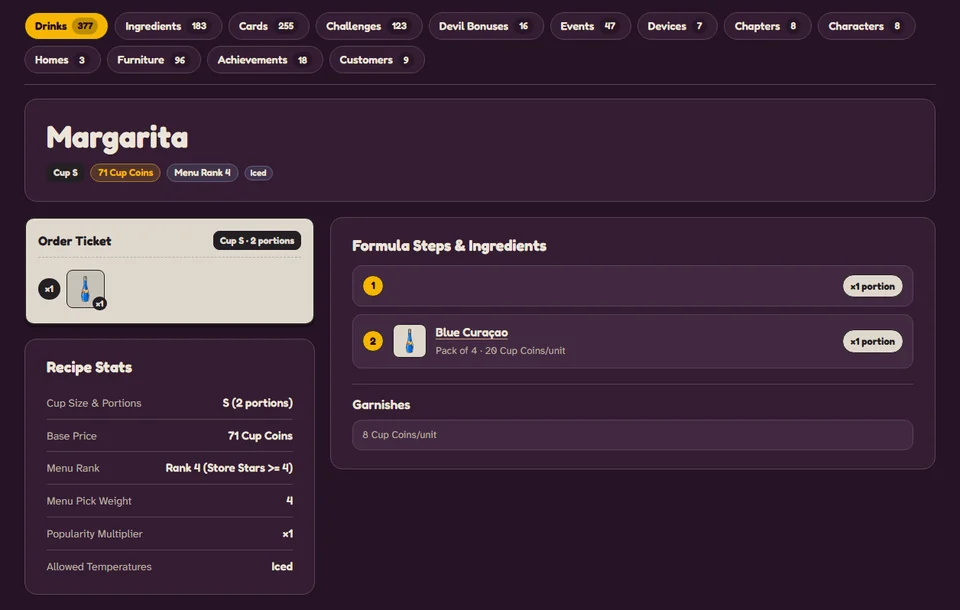
- Shaken drink examples and payouts: shaken bases power drinks from small Gimlet (rank 2, base price 36), small Margarita (rank 4, base price 71, combining a shaken base with Blue Curaçao), and medium Brandy Sour (rank 3, base price 96) up to
 Tequila Sunrise (rank 9, base price 341),
 Orange Ocean (rank 10, base price 423), and Jack Rose (rank 10, base price 435).
Preparing six servings at once in a Shaker triggers a flair bartending throw; timing the catch awards four extra servings of liquor, whereas a missed catch raises stress. The character  Beaver widens that catch judgment window through the Etiquette skill. For Shaker upgrade cards,
 Commercial Shaker grants 1 extra portion of liquid for every 3 shaken portions, and Commercial Shaker+ raises that output to 2 extra portions per 3; both cards pour the extra liquid into the glass first.
Unlocking Bar Street and Handling Bar Customers
Bar Street is chapter 8 of the 8 chapters (32 stages across the campaign, 4 per chapter) and opens once you clear Stage 4 of Amusement Park. Clearing 4 stores in Bar Street on the lowest difficulty unlocks the  Tipsy Hour achievement and awards the Blueprint: House with a Garage.
The demo covers Stages 1 through 3 of Residential Area, so Bar Street unlocks in the full game. For how every chapter unlocks across the campaign and what the demo includes, review the chapters and stages guide.
Bar service also brings three customer habits worth watching once you step behind the counter:
- Counter ordering and pickup tables: approach patrons waiting at the bar counter to take their orders, then deliver finished drinks onto tables marked Pick Up so customers walk over to grab them.
- Tipsy wanderers: patrons who struggle with liquor stumble around carrying their glass and can wander into the kitchen; bump into them gently to wake them so they put the cup down and leave.
- Wine Glass patrons: the Wine Glass customer shares only a brief prompt and relies on bartender improvisation, though the poured liquid still must follow a real recipe on your active menu.
In This Guide
Sources
- Feed the Cups game files (Steam build 25975646 (demo 2400400, extracted 2026-11-21))
- Steam Developer Announcements — Feed the Cups (App 2336220)https://store.steampowered.com/news/app/2336220/
- Steam store screenshots and developer announcements (Steam App 2336220)