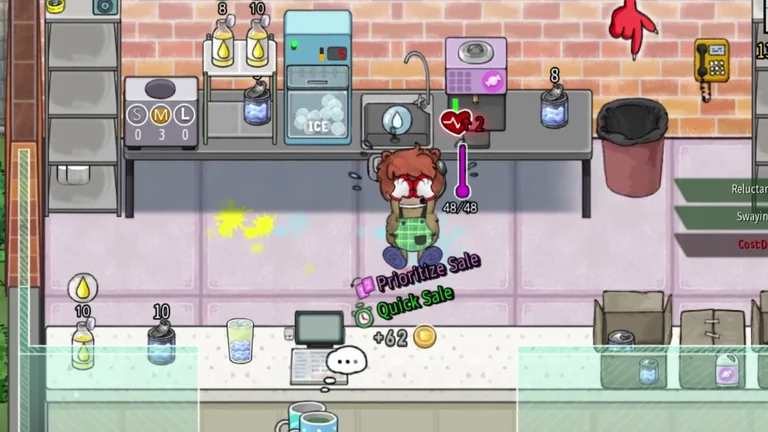
Feed the Cups Sago and Tapioca Pearls: How to Cook and Use
How to boil Bagged Sago into Sago in a large pot on an Induction Cooker, pack costs and batch yields, drinks that use Sago, and how it differs from Boba Pot tapioca pearls.
Part of Feed the Cups Drinks and Recipes Guide: Sizes, Ranks, Devices, and Top Prices.
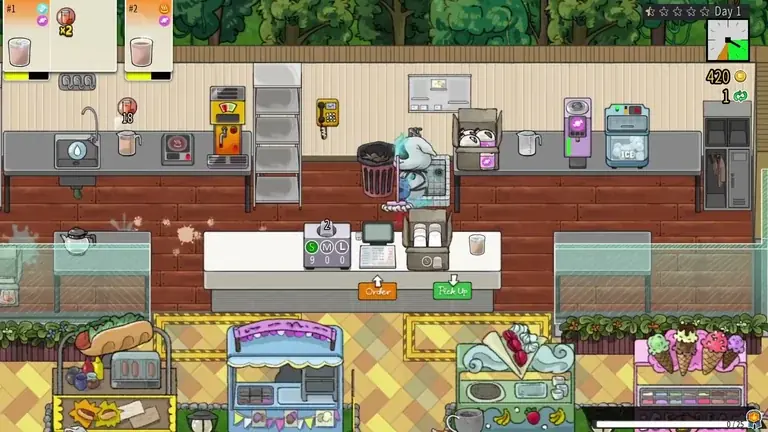
To prepare  Sago in Feed the Cups, buy
 Bagged Sago (4 bags per box at 25 cup coins per bag), fill a large pot with water (1 unit for 1 bag or 2 units for 2 bags), heat the pot to boiling on an Induction Cooker, add the bags, boil until done without overcooking, strain at the sink, and pour the batch into a topping container. Each cooked large-pot batch outputs 10 servings into the topping container—a yield of 5 to 10 servings per bag depending on batch size—and Sago adds 38 cup coins to orders such as
 Rose Sago Soup,
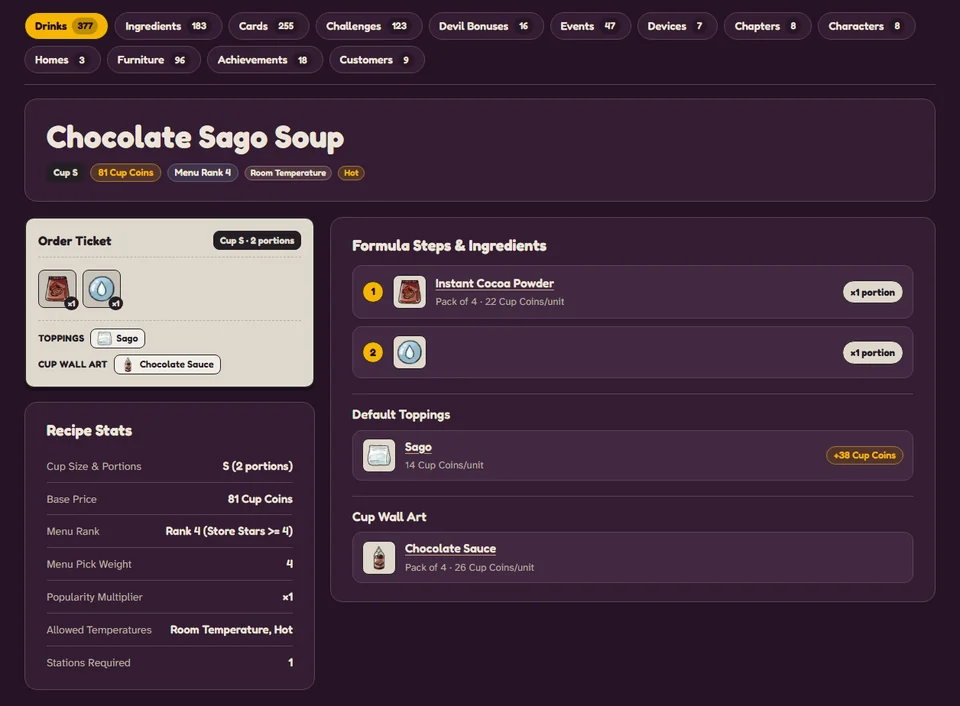
 Chocolate Sago Soup, and
 Alpine Snow White (note that
 Mango Pomelo Sago uses fruit jams rather than Sago). For how toppings fit into menu tiers and full drink formulas, read our drinks and recipes guide.
How to Cook Bagged Sago Step by Step
To cook Bagged Sago, you need a large pot (200 cup coins in the equipment shop), an Induction Cooker (3,000 cup coins), a sink for draining, and a topping container stored in cold refrigeration.
- Fill a large pot with water up to its 2-unit capacity: half a pot cooks 1 bag of Bagged Sago, while a full pot handles 2 bags in one batch.
- Place the pot on an Induction Cooker and wait until the water reaches boiling before adding Bagged Sago, because dropping it in too early triggers a “Not hot enough” message.
- Let the Sago boil until cooked and remove it before it overcooks.
- Carry the pot to the sink to strain off the water, then empty the cooked Sago into a topping container and place that container in the refrigerated topping station.
If a batch overcooks, you still have to drain it at the sink before throwing the ruined Sago into the trash cans. Before ending the shift, clear the Induction Cooker, empty any large pot, and refrigerate every topping container; leaving an Induction Cooker on overnight creates a safety hazard with a high electricity bill, and unemptied pots or unrefrigerated containers trigger closing-time warnings.
Two upgrade cards apply to the Induction Cooker once the appliance is active on a level: 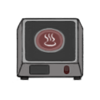 Commercial Induction Cooker grants +25% efficiency, and its upgraded card Commercial Induction Cooker+ raises efficiency by +75% and stops insulation from consuming power. For general boiling, cooling, and straining routines across other stations, see our drink preparation steps guide.
Pack Size, Cost, and Batch Yield
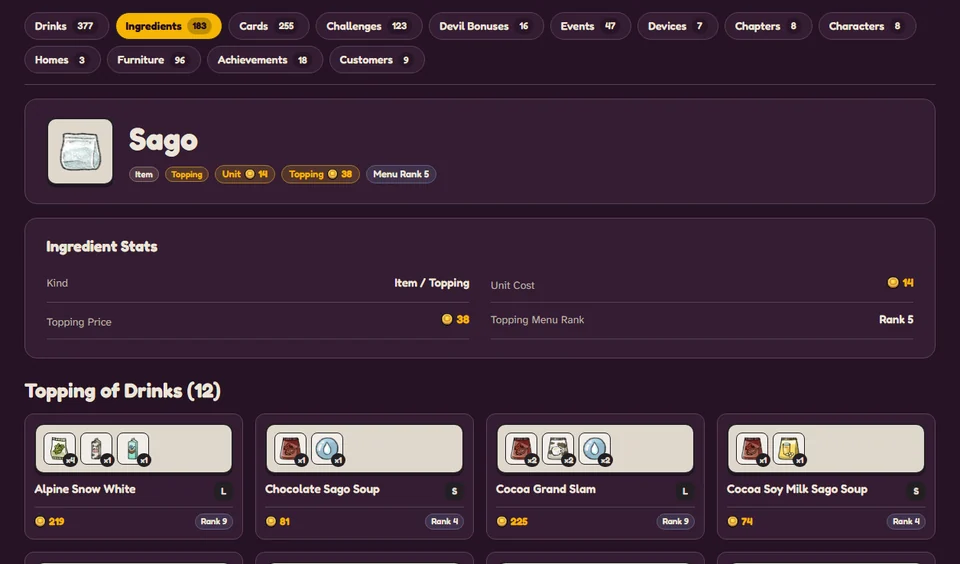
- Delivery box cost: Bagged Sago ships in boxes of 4 bags priced at 25 cup coins per bag, with total box cost calculated as pack size times unit price before active challenge price modifiers.
- Raw bags require cooking: Bagged Sago is prepared in a large pot before serving rather than added directly into drink formulas.
- Batch yield: every completed large-pot batch drops 10 servings of Sago into a topping container while consuming either 1 bag (half pot) or 2 bags (full pot), leaving a yield range of 5 to 10 servings per bag.
- Menu rank and topping price: once cooked, Sago unlocks at menu rank 5 and carries a topping sale price of 38 cup coins.
- Missing-topping deduction: you can still sell a fixed-topping order when out of Sago, though its topping price of 38 cup coins is deducted from the drink’s base payment.
- Storage and spoilage: unopened packs of Bagged Sago have no overnight spoilage timer, whereas cooked Sago spoils after a single day unless kept cold; refrigerating the container preserves leftovers as stale stock for one extra day before they spoil.
Drinks That Use Sago
After cooking, Sago appears as a fixed topping across milk, soy, and tea orders starting at menu rank 3 and going up to 10:
- Ranks 3 to 4: Rose Sago Soup (S cup, rank 3, 49 cup coins),
 Soy Milk Sago Soup (M cup, rank 4, 65 cup coins), Cocoa Soy Milk Sago Soup (S cup, rank 4, 74 cup coins), and Chocolate Sago Soup (S cup, rank 4, 81 cup coins).
- Ranks 6 to 7: Rose Soy Milk (M cup, rank 6, 167 cup coins, with
 Grass Jelly),
 Coconut Rose Sago Soup (M cup, rank 7, 137 cup coins), Lemon White Tea with Sago (M cup, rank 7, 145 cup coins), and Iced Crimson Cocoa (L cup, rank 7, 173 cup coins).
- Ranks 9 to 10: Alpine Snow White (L cup, rank 9, 219 cup coins, with
 Taro), Cocoa Grand Slam (L cup, rank 9, 225 cup coins, with
 Red Beans and
 Nata de Coco),
 Fully Loaded Cocoa Soy Milk (L cup, rank 10, 313 cup coins, with Grass Jelly and Nata de Coco), and Dark Chocolate Soy Milk (L cup, rank 10, 328 cup coins, with Grass Jelly).
Does Mango Pomelo Sago Use Sago?
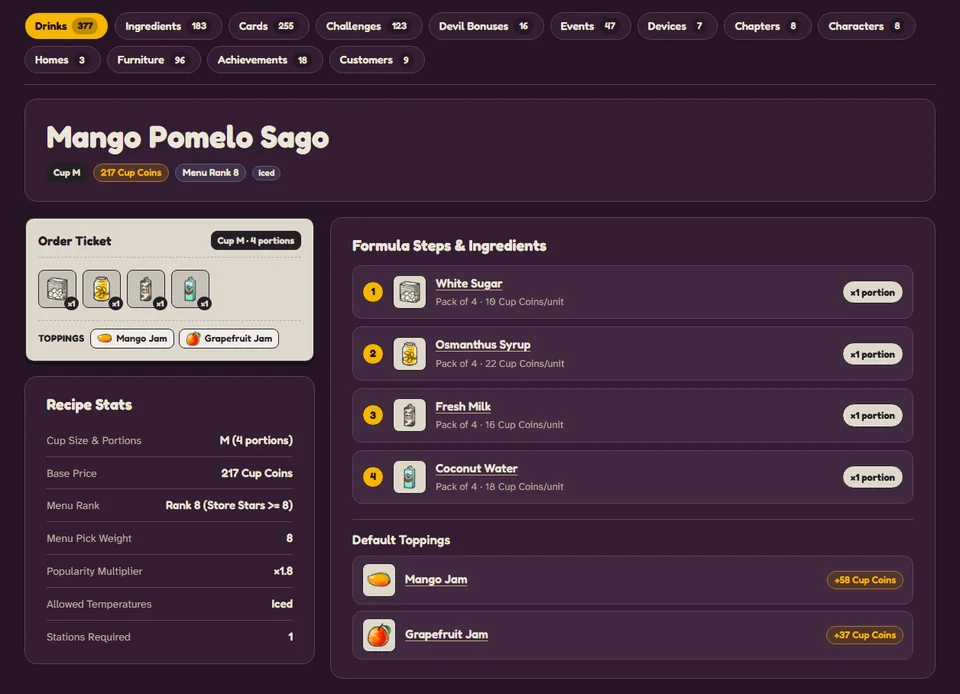
Despite its name, Mango Pomelo Sago (M cup, rank 8, 217 cup coins, served iced only) does not use cooked Sago. Its formula combines 1 portion each of  White Sugar,
 Osmanthus Syrup,
 Fresh Milk, and Coconut Water, topped with
 Mango Jam and
 Grapefruit Jam instead. You do not need to keep a pot of Bagged Sago boiling just because Mango Pomelo Sago rolls onto your menu.
Sago vs. Tapioca Pearls (Boba)
Sago and boba are separate toppings prepared on different stations:
- Appliance and overcooking: Sago boils in an open large pot on an Induction Cooker and can overcook if neglected, whereas
 Bagged Boba (6 bags per box at 10 cup coins per bag) cooks in a Boba Pot (700 cup coins) equipped with a timer and automatic lid opening so pearls do not overcook.
- Sugar simmering and yield: in contrast to Sago, strained boba goes back into the Boba Pot with sugar—White Sugar produces Original Boba (rank 7, priced at 40 cup coins) and
 Brown Sugar produces Brown Sugar Boba (rank 7, priced at 28 cup coins)—at 10 pieces per bag.
- Full boba workflow: see our boba cooking guide for complete Boba Pot timing and recipe pairings.
- Shared large-pot routine: Taro (6 per box at 20 cup coins each) uses the same large-pot rule as Sago, fitting 2 portions in a full pot of boiling water after you cut it on a chopping board.
In This Guide
Sources
- Feed the Cups game files (Steam build 25975646 (demo 2400400, extracted 2026-11-21))
- Developer gameplay footage